About the Game – A Brief Introduction
Mars is searing in popularity at the moment, not only on the table with Terraforming Mars, one of
many Tabletop Games based around the planet but also through films, TV and not forgetting actual
projects to physically get us there. Whilst most of us would not have been around to witness the first
man on the moon there is a real possibility that we will get to see the first person on Mars so it’s no
surprise it has become so relevant in the media.
In Terraforming Mars the premise is relatively simple, you play as one of several corporations
seeking to play a pivotal role in the terraforming of the planet through turning the red waste into a
green and blue wonderland with Forests, Oceans, Cities, wildlife and various other spectacles spread
throughout the planet.
The game itself is designed by Jacob Fryxelius and published by Stronghold Games. It is 1-5 players;
however, this review will not include the solo play, and takes approximately 120-180 minutes to
play. The reason for the large disparity in play time is due to a couple of factors; there are variations
in some of the rules which can extend/shorten game time, we will come to these later, and the game
ends when 3 shared goals are achieved which every player will at some point contribute towards,
therefore there can be a reluctance to end the game if you feel you are falling behind or you just
want to play that one more card, which can cause the game to be stretched out longer than
necessary. However, if you’re like me, you will want the game to take as long as possible as once you
finish playing you won’t be able to stop thinking about getting it back on the table.
Components
Now I want to address this before going into the spectacular gameplay. The components of this
game will more than likely leave you feeling deflated. Whilst the cubes used to track your resources
are nice, shiny and feel solid, after just a couple of plays the metallic paint was already starting to
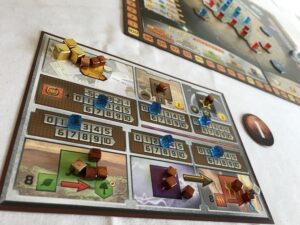
chip off the corners. The player mats are thin with a shiny surface, which is far from ideal when
placing your cubes on them as a small knock can send everything flying and remembering where you
were on each of the 6 tracks is far from easy if you have a memory like me. The board itself is small
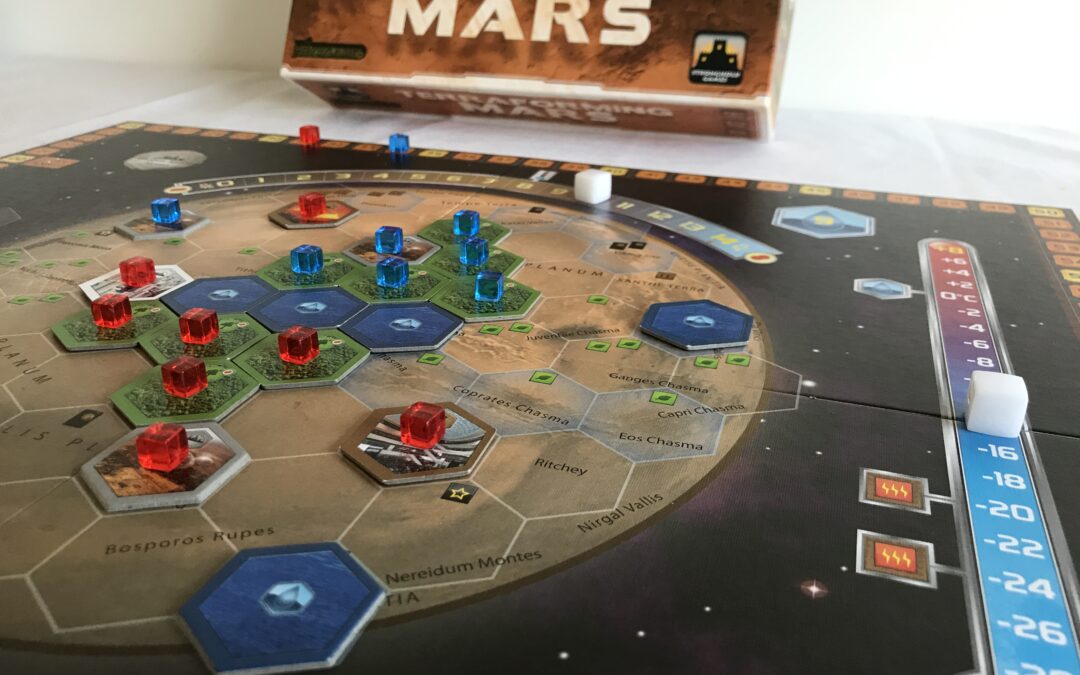
but it contains everything you need, unfortunately the markers on the board and the hexagonal
cardboard tiles you place on it are what is required but nothing more. Thankfully you’ll spend at
least half of your time looking at the cards, which are of a better quality even if the artwork is
inconsistent at best,
As I said, it will leave you feeling underwhelmed and after a few games you will be yearning for a
special edition with upgraded components, however in spite of this, you can’t help but love this
game.
Gameplay
Now this is where the game grabs you and doesn’t let go. As mentioned previously, the objective of
the game is to achieve 3 key milestones in terraforming the planet- Raise the mean temperature to 8
degrees Celsius, increase the oxygen to 14% and place 9 ocean tiles. Whilst you all work towards
these shared goals this is by no means a co-operative game, think of it as a race to be the biggest
contributor to the colonisation of Mars. Each round (referred to in game as a ‘Generation’) has 3
distinct phases – Research, Action and Production.
During the ‘Research Phase’ each player draws 4 cards which they are then able to purchase for
3M€ each (that’s 3 Mega Credits not Euros!). These will add to any cards the player already owns
and form their hand and can range from importing hydrogen to laying an ocean tile, building a
nuclear power plant or even introducing pets to cities.
The main phase follows in the ‘Action Phase’. Each player takes it in turns to perform 1 or 2 actions
until every player has passed or can no longer perform an action. These actions include playing a
card, undertaking a standard project, converting plants into forest tiles, converting heat to raise the
temperature and claiming milestones or awards. Whilst there is no limit to how many actions
someone can perform each generation you will be restrained by the amount of resource at your
disposal, this is where the core strategy of the game comes into play. How you manage your
resources, which projects you undertake and when will be pivotal in how well you score come the
end of the game, however if you are too rigid in your approach and can’t be flexible on strategy you
can easily fall short when it counts. You can play the long game, build up you resource creation and
save up for those big hitters only to find your plans ruined when someone triggers the end game by
advancing several steps of the terraforming objectives in one generation. Likewise, you can find
yourself backing an award you feel you a dead cert for only for someone to be hiding that killer card
waiting for this opportunity to steal the points away from you.
The final stage of a Generation is the ‘Production Phase’, which no surprise here is where you
produce materials to use in future generations. There are 6 unit types to produce, as long as you
have at least 1 production in that unit type of course: MegaCredits, Steel, Titanium, Plants, Power
and Heat. We’ve already touched on our Mars currency as well as both heat and plants, as for the
others, Steel is worth 2M€ when playing a card in which buildings are constructed, Titanium is worth
3€ for space cards and power is used to either pay for an action on a card or the production of it can
be reduced to permanently power a construct such as a city of power plants. At the start of each
production phase all unused power is converted into heat to be used in following generations.
Whilst I don’t want to go into every intricacy of the game here I do want to mention the Awards and
Milestones. The latter are rather straightforward, if at any time you have fulfilled the requirements
of one of the five Milestones you can spend an action and 8M€ to claim the milestone, these range
from owning at least 3 cities to having 16 cards in your hand. Come the end of the game these are
worth 5 victory points each but only 3 of the 5 can be claimed. The Awards are a much more tricky
affair as they can be funded at any time by any player but only pay-out at the end of the game to the
person who wins the category, who may not be the person who funded the award in the first place.
These range from owning the most tiles in play to having the most Heat Resource cubes. In addition,
the first award to be funded only costs 8M€ however the second rises to 14M€ and the third and
final one to 20M€, rewarding those brave enough to fund an award early but increasing the risk of
another player reaping the benefits.
Final Thoughts
Terraforming Mars is a brilliant game, with hidden and not so hidden depths. There is so much to
talk about that I haven’t even touched on several of the game’s parts, including the Corporations
which each player acts on behalf of having a special ability to help you decide on potential strategies,
the Corporate Era expansion included in the base game which introduces around 50% more cards to
the game and 2 extra corporations, the draft variant which adds some fun to the Research Phase and
the Solo variant, which at the time of writing I am yet to venture into to.
There is no hiding that this game has its flaws, the components are steeped in mediocrity, the play
length can be an issue for those who like to keep their gaming sessions under the 3-hour mark and
of course the game is complex, not your average Euro complexity but at a level which some players
will find too much. With cards having prerequisites to play and knock on effects, often in the late
game playing one card will result in 5 or 6 other things having to happen, our record to date is a
single card which either was effected by or had an effect on 9 other cards, points, resources or
requirements. As you can imagine, this can be hard to keep track and not suited for those who enjoy
the lighter side of Tabletop Gaming.
I don’t love Terraforming Mars in spite of this; I love it because of this. The components are like that
kid in school who looked weird, didn’t have many friends and definitely wasn’t part of the ‘cool’
crowd, yet you couldn’t help notice their strange charm and after a while realised that you wouldn’t
want them to change to fit in with the other kids because then they wouldn’t be them (and if you
think I’ve described yourself then don’t worry, you’re not alone in this). The complexity is what will
bring you back to the game, time after time and get excited about the next time you play before
you’ve even finished counting the scores up. And I like my games long but if you don’t then you can
strip it back to the base rules and not play with the extra cards to keep the game time to under 2
hours. You can even pick up a great quality organiser by Broken Token, which fixes the issue with
components if you don’t mind dropping another £50 on something that adds no gameplay value.
Overall, Terraforming Mars is my favourite game of 2017 and one of my favourites ever; I would
highly recommend it, that’s if you can get your hands on a copy of course!
James Hyde
Pros
Great game mechanics
Tons of replayability
Very little downtime maximising engagement
Cons
Questionable component quality
Long playing time may put some players off
Layers of complexity may prove too much for some players
Scoring
Overall: 92/100
Components: 3/5
Replayability: 5/5
Engagement: 5/5
Player Interaction: 3/5